
05 – Photographic Objects / Darkroom

VAL D’ASTICO
Experimental darkroom work, 2026
Analogue black-and-white photography
Minolta Dynax 7xi
Kodak T-Max 100
Self-developed in Fomadon R09
Hand-printed in the darkroom on ILFORD MULTIGRADE FB Classic Glossy
Silver gelatin print
12.7 × 17.8 cm
A landscape almost disappearing into mist becomes the starting point for an exploration of photographic exposure.
In the darkroom, successive vertical bands of light divide the same image into different tonal states. Nothing in the landscape moves, yet our perception of it changes from one passage to another — from emergence to obscurity, from visibility towards disappearance.
The printing process is no longer simply a means of reproducing the negative. It becomes part of the image itself: exposure, time and light are made visible.
The landscape becomes both subject and photographic object — suspended between representation, memory and the material experience of seeing.

01 - successive vertical bands of light

02 - VAL D’ASTICO, 06, 2026

SEARCHING FOR THE TONES — SELF-PORTRAIT
Photographic Objects / Darkroom
Experimental silver gelatin print
This self-portrait emerged from a darkroom experiment concerned with the search for tonal balance.
Rather than using exposure and filtration simply to arrive at a single “correct” print, successive areas of the photographic paper were exposed through different combinations of magenta and yellow filtration. Vertical bands, approximately 20 mm apart, explore variations of contrast; these are crossed by horizontal passages of changing exposure and filtration.
The resulting grid preserves the process of testing within the finished image.
Across the same face, shadow, mid-tone and highlight continually change their relationships. No single tonal interpretation is allowed to dominate. Instead, several possible versions of the photograph coexist on one sheet of silver gelatin paper.
What would normally remain an invisible stage of darkroom work — testing, adjusting, comparing and searching — becomes the visible structure of the photograph.
The self-portrait is therefore both image and test, representation and photographic object. The darkroom no longer serves simply to reproduce the negative; it becomes a space in which the image is constructed through light, time and contrast.
Searching for the Tones makes that search itself part of the work.

TREE / CIRCULAR EXPOSURES
Diptych, 2026
Analogue black-and-white photography
Leica M6
Kodak Tri-X 400
Self-developed in Rodinal
Hand-printed in the darkroom on Fomaspeed Variant 311
Silver gelatin prints
12.7 × 17.8 cm each
The diptych presents two states of the same photographic image.
On the right, the tree remains relatively intact: trunk, branches, hanging foliage and surrounding space are described through the tonal structure of the negative.
On the left, the image becomes a field of intervention. Circular areas interrupt the photographic surface, introducing different densities of light and transparency across the tree.
These circles do not illustrate anything within the landscape. They belong to the darkroom process itself. By masking, exposing and allowing certain areas to receive different amounts of light, the photographic paper becomes an active surface rather than a passive support.
The result is no longer simply a photograph of a tree. It becomes a negotiation between image, light and photographic material.
Placed beside the untreated version, the transformed print reveals how a single negative can generate several possible images. The diptych therefore makes visible the distance between photographing and printing — between the image captured by the camera and the image constructed in the darkroom.
The darkroom does not merely reproduce the photograph; it becomes a place where the photograph can be rewritten.

Satigny, 2025, Silver Gelatin Print, ( rectangular tonal fields and photographed scene ) 4 x (17,8 x 24) cm

Satigny #1, 2025, Silver Gelatin Print on ILFORD MGRC Glossy, 17,8 x 24 cm

Satigny #2, 2025, Silver Gelatin Print on ILFORD MGRC Glossy, 17,8 x 24 cm
05 — Photographic Objects / Darkroom
Working Landscape — Satigny
Satigny, Geneva, 2025
These photographs were made in a friend’s vineyard in Satigny, Geneva. Rather than presenting the vineyard through the familiar image of vines and rural beauty, the first view turns toward its working infrastructure: tractors, trailers, agricultural vehicles, storage and equipment gathered beside the vineyard.
The landscape is therefore understood not only as something to contemplate, but as a place of labour, movement and production.
In the darkroom, the same negatives are approached differently. One print preserves the continuity of the photographed scene, while the other is divided into a sequence of rectangular tonal fields. Changes in exposure become visible across the surface, producing a grid that interrupts the apparent unity of the landscape.
In the upper image, this intervention is particularly interesting: the machinery remains relatively solid while the distant landscape begins to dissolve into successive tonal zones. In the lower image, the winding road passes through the grid, linking photographic depth with the flat geometry imposed by the printing process.
The two states placed side by side reveal that the photographic image is not fixed at the moment of exposure. The negative contains possibilities; the darkroom becomes the place where these possibilities are tested and made visible.
The landscape is therefore both subject and material: a view of a working vineyard, but also a surface on which light, exposure and time can be reorganised.
Technical details
Analogue Photography
Leica M6 · AGFA APX 400
Rodinal 1+100 · 75 min. stand development
Hand-printed in the darkroom on ILFORD MULTIGRADE RC Glossy
17.8 × 24 cm
05 — Photographic Objects / Darkroom
Drawing / Film / Mask / Self-Portrait
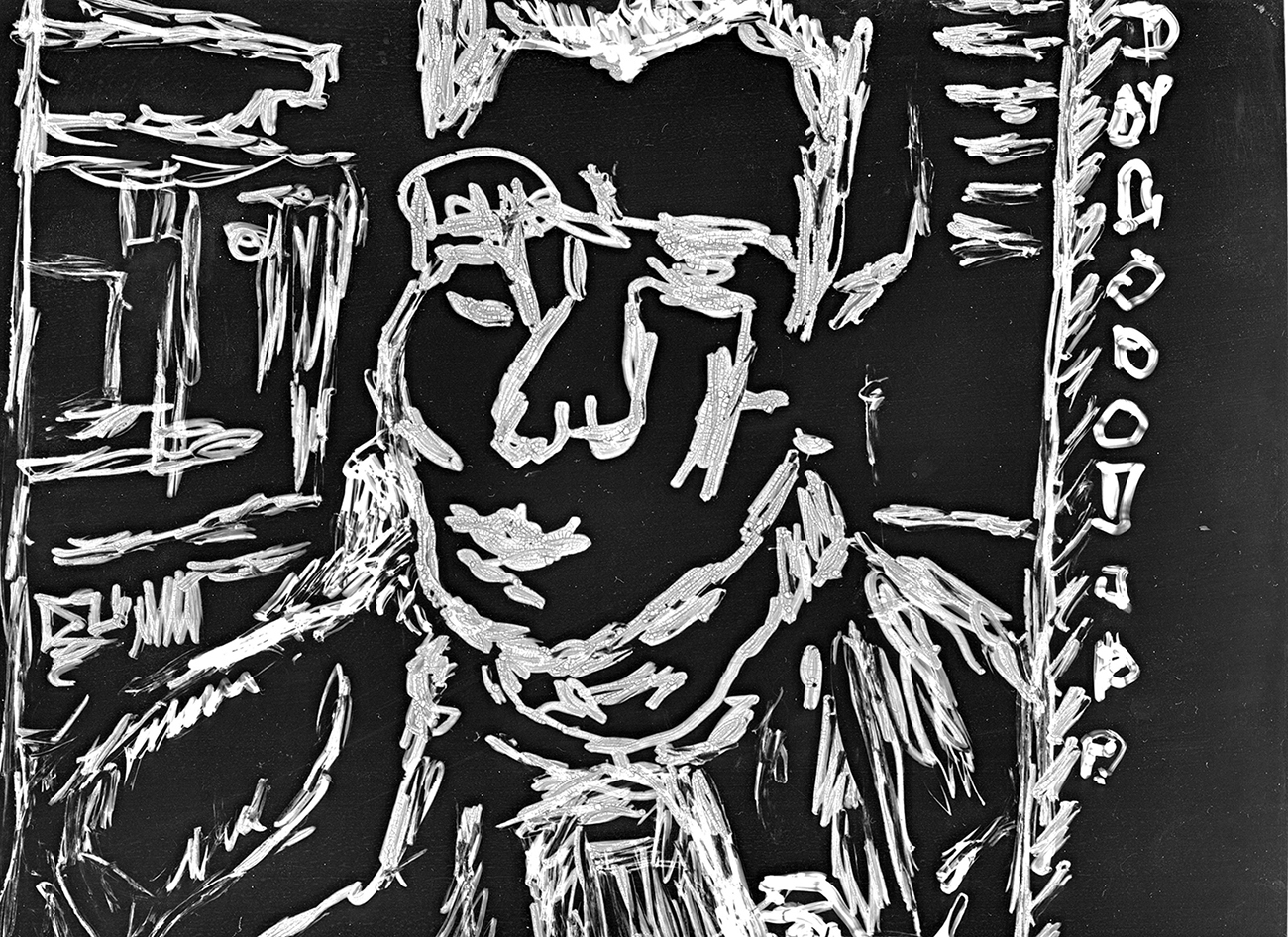
This work began with failure.
A sheet of medium-format film, unsuccessfully developed and left without a photographic image, was retained rather than discarded. I began drawing directly onto its surface with ink. The material resisted the gesture: the ink did not adhere easily to the smooth film, producing broken lines, accumulations and irregular marks.
What had failed as a photograph consequently became a surface for drawing.
The resulting image resembles a face, but one that is unstable and fragmented. White and grey marks emerge against the dark ground; lines hesitate, break apart and overlap. The resistance of the film becomes visible within the drawing itself.
The altered film was then used photographically and printed in the darkroom on ILFORD MGRC Glossy paper at 30 × 30 cm. At this point, drawing and photography become difficult to separate: a drawing made on photographic film is transformed by light into a photographic print.
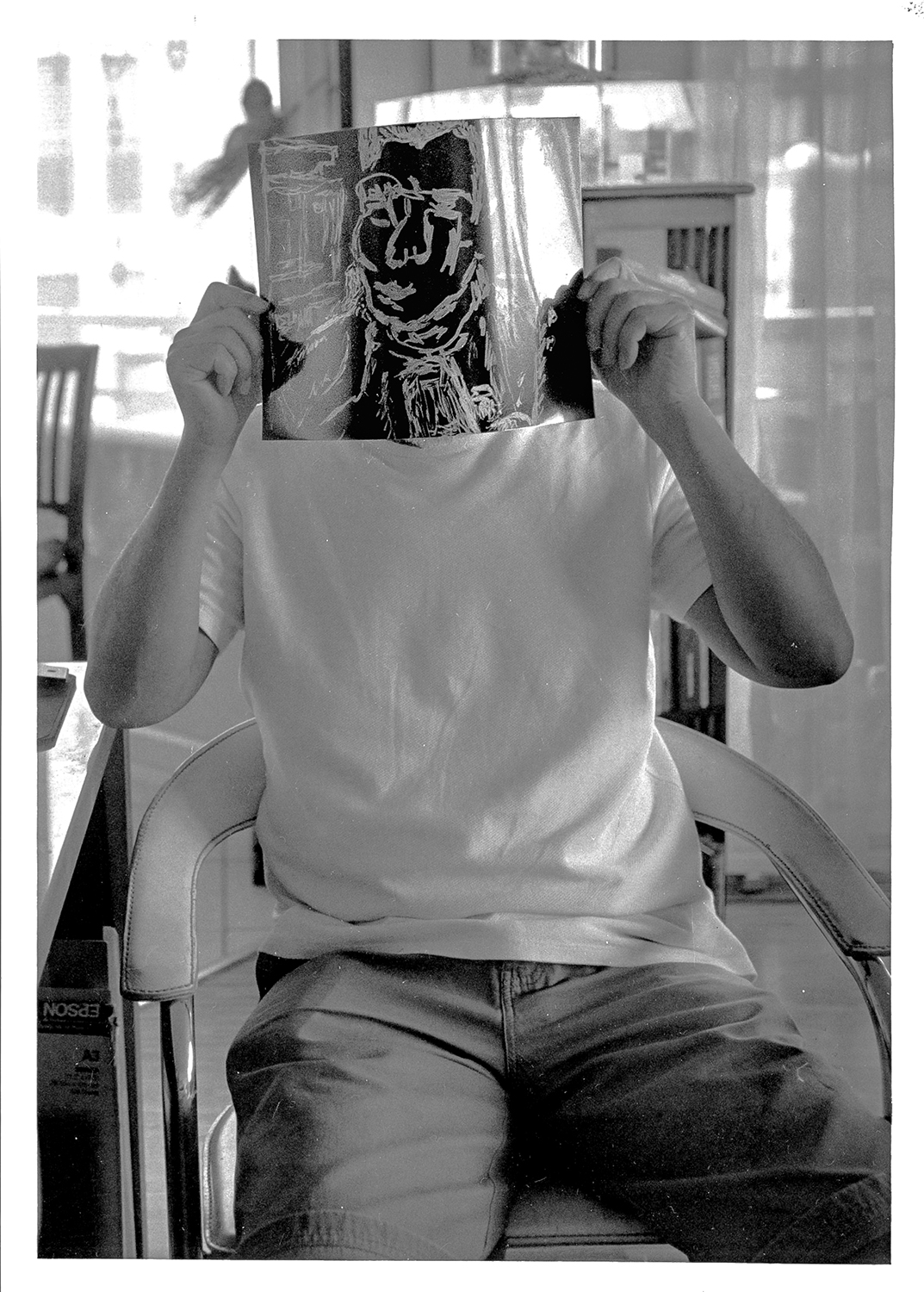
The process continues in the self-portrait. I hold the finished print in front of my own face, using the image as a mask. My physical face disappears and is replaced by another face — one that originated not from the camera, but from drawing, material resistance and photographic failure.
The hands remain visible, holding the constructed face in position. This simple gesture is important: it reveals the mask as an object rather than creating an illusion. The portrait shows simultaneously the body, the image and the act of placing one in front of the other.
What began as an empty negative therefore moves through several states:
failed film → drawing → negative/object → darkroom print → mask → self-portrait.
The failure is not corrected or concealed. It becomes the starting point of the work.
Drawing directly on medium-format film · ink · darkroom silver-gelatin print on ILFORD MULTIGRADE RC Glossy · 30 × 30 cm · print subsequently used as a mask for a photographic self-portrait.
Drawing directly onto film surface with ink and print on ILFORD MGRC Glossy, 30 x 30cm
Self-Portrait Holding the finished print in front of my own face, using the image as a mask


From darkroom print to installation
The project now moves from the intimate scale of the darkroom toward an architectural scale. I imagine enlarging the diptych to approximately two metres in height and installing the two photographs directly on the floor, leaning against the stone wall of a monastery or other contemplative space near Duingt.
At this scale, the work would no longer function simply as a photograph hanging on a wall. The body of Christ would approach human scale, and the two images would become almost physical presences within the architecture.
Placing them on the floor rather than hanging them conventionally is important. It removes some of the distance associated with a museum display. The photographs inhabit the same ground as the visitor. They remain photographic objects, but they also begin to behave like an installation….Continue reading