
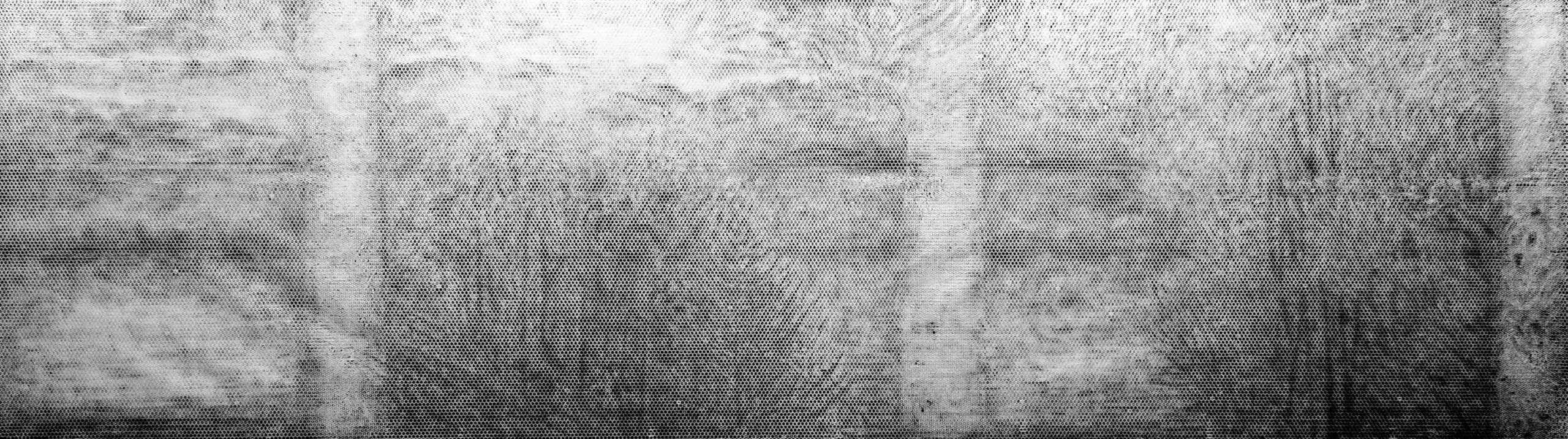
Synthetic Landscape, 2018, Synthetic paint on bubble wrap, 150 × 535.5 cm
Synthetic Landscape, 2018
Synthetic paint on bubble wrap, 120 × 430 cm
In Synthetic Landscape, painting is inseparable from the physical structure of its support. Applied directly onto industrial bubble wrap, the paint catches primarily on the raised circular surfaces, fragmenting the image into thousands of small points. The process produces an effect almost opposite to screen printing: rather than surrounding the circular forms, the pigment occupies the bubbles themselves.
At close range, the landscape dissolves. The eye encounters a field of circles, traces, interruptions and painted matter. From a distance, however, these individual units become increasingly small within the viewer’s perception and begin to merge. Mountains, vegetation, sky and trees gradually appear. The monumental scale of the work—more than five metres long—is therefore essential: it invites the viewer to move backwards and forwards, continuously shifting between material surface and represented space.
The bubble wrap also carries traces of its own industrial manufacture. At regular intervals of approximately two metres, vertical irregularities recur across the roll. Rather than eliminating these accidental marks, I incorporated them into the painting, allowing them to become three vertical tree-like forms within the landscape.
The image thus emerges from a negotiation between intention and accident. What initially belongs to the manufacture of a synthetic material becomes part of a natural landscape; an industrial defect becomes a tree.
Synthetic Landscape is therefore less concerned with representing a particular place than with the conditions through which an image becomes visible. From nearby there is surface; from afar there is landscape. Between the two lies the act of seeing.

Details — Synthetic Landscape, 2018
Seen at close range, the landscape dissolves into its material structure. The surface of the bubble wrap fragments the painted gesture into thousands of individual circular marks. Each bubble acts almost like a pixel, receiving the paint differently and transforming the continuity of the brushstroke into a field of repetitions, variations and interruptions.
The details also reveal irregular vertical traces produced during the industrial manufacture of the bubble wrap. Rather than concealing these accidents, I allowed them to enter the composition. Their recurring presence becomes the structure of the trees within the landscape.
What appears from a distance as mountain, sky, vegetation or tree is therefore constructed from something entirely different when approached closely: plastic, paint, circles, traces and accidents.
The landscape exists between these two distances—between material and image, accident and intention, abstraction and recognition.

Details — Synthetic Landscape, 2018
The landscape exists between these two distances—between material and image, accident and intention, abstraction and recognition.