
English
Within IMAGO SENSIBILIS / IMAGE MENTALE, Siripoj Chamroenvidhya approaches photography as an archaeology of perception. Rather than recording the visible world, Palimpsest of Ruins investigates how memory survives through layers of time, where history is never fixed but continually rewritten by experience and imagination.
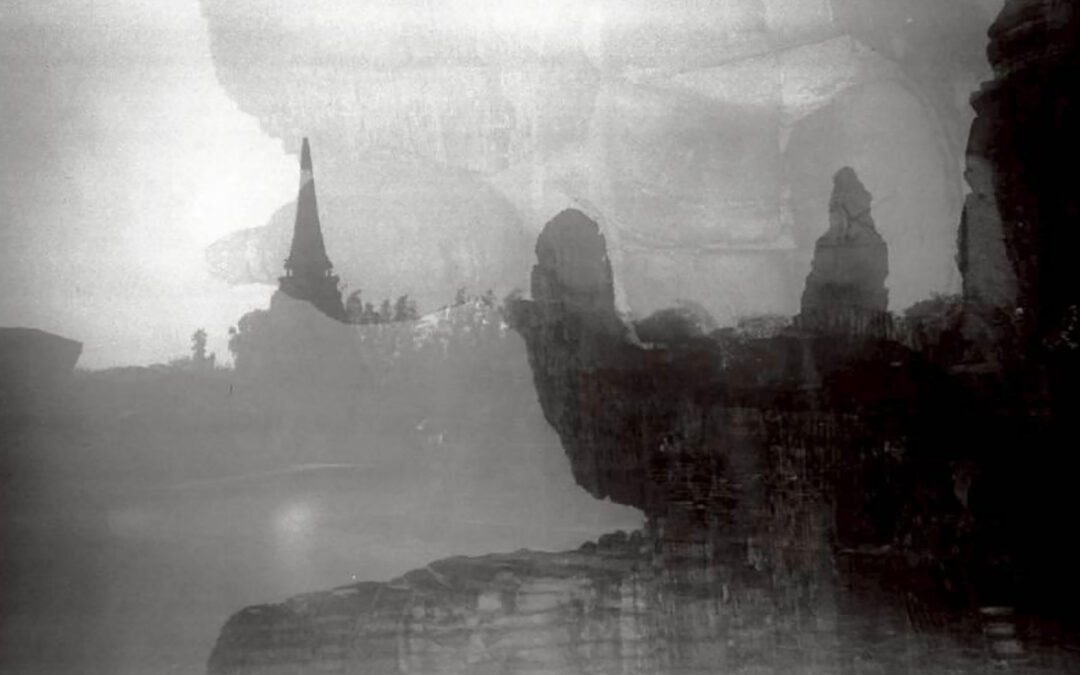
Photographed among the ancient temples of Ayutthaya using a 1936 Agfa Billy Record and Kodak Tri-X 400 film, the series employs intentional double exposure to superimpose architectural fragments, sculptural remains, light, and atmosphere within a single negative. The resulting images dissolve the certainty of documentary photography, replacing objective description with a visual field where multiple temporalities coexist.
The notion of the palimpsest—a manuscript repeatedly erased and rewritten—becomes the conceptual structure of the work. Each photographic layer preserves traces of previous moments while generating new relationships between visible and invisible histories. The ruins no longer appear as archaeological objects; they become living memories whose meanings continue to evolve.
At the level of Imago Sensibilis, grain, light, optical imperfections, and overlapping forms create an immediate sensory experience. The materiality of analog photography allows time itself to become tangible, transforming technical limitations into expressive language.
Gradually, the work unfolds toward Image Mentale, where photography ceases to document monuments and instead becomes an image of consciousness itself. The superimposed negatives mirror the way memory operates—not as linear recollection, but as a continuous accumulation of fragments, sensations, and imagined reconstructions.
In Palimpsest of Ruins, history is not represented; it is re-experienced. The photograph becomes a place where past and present inhabit the same image, inviting viewers to recognize memory as an active process of perception rather than a record of what has disappeared.
Français
Dans IMAGO SENSIBILIS / IMAGE MENTALE, Siripoj Chamroenvidhya envisage la photographie comme une archéologie de la perception. Plutôt que d’enregistrer le monde visible, Palimpsest of Ruins interroge la manière dont la mémoire subsiste à travers les strates du temps, où l’histoire n’est jamais figée mais constamment réécrite par l’expérience et l’imagination.
Photographiée dans les ruines d’Ayutthaya avec un Agfa Billy Record de 1936 et une pellicule Kodak Tri-X 400, la série utilise la double exposition intentionnelle afin de superposer fragments architecturaux, sculptures, lumière et atmosphère sur un même négatif. Les images obtenues dissolvent la certitude documentaire de la photographie au profit d’un espace visuel où plusieurs temporalités coexistent.
La notion de palimpseste — manuscrit effacé puis réécrit au fil du temps — constitue la structure conceptuelle de l’œuvre. Chaque strate photographique conserve les traces d’un moment antérieur tout en produisant de nouvelles relations entre histoires visibles et invisibles. Les ruines cessent alors d’être de simples vestiges archéologiques pour devenir des mémoires vivantes dont le sens demeure en perpétuelle transformation.
Au niveau de l’Imago Sensibilis, le grain, la lumière, les imperfections optiques et les superpositions produisent une expérience sensorielle immédiate. La matérialité de la photographie argentique rend le temps presque palpable, transformant les limites techniques en véritable langage plastique.
Progressivement, l’œuvre s’oriente vers l’Image Mentale, où la photographie ne documente plus des monuments mais devient l’image même du fonctionnement de la mémoire. Les négatifs superposés reflètent la manière dont le souvenir se construit : non selon une chronologie linéaire, mais par l’accumulation de fragments, de sensations et de reconstructions imaginaires.
Dans Palimpsest of Ruins, l’histoire n’est pas représentée ; elle est réactivée. La photographie devient un lieu où passé et présent habitent simultanément une même image, invitant le regardeur à considérer la mémoire comme un processus vivant de perception plutôt que comme l’archive d’un monde disparu.
ภาษาไทย
ภายใต้แนวคิด IMAGO SENSIBILIS / IMAGE MENTALE ศิริพจน์ จำเริญวิทย์ มองการถ่ายภาพในฐานะ « โบราณคดีแห่งการรับรู้ » มากกว่าการบันทึกโลกที่มองเห็น ผลงาน Palimpsest of Ruins สำรวจว่าความทรงจำดำรงอยู่ผ่านชั้นของกาลเวลาอย่างไร โดยมองว่าประวัติศาสตร์มิใช่สิ่งตายตัว หากเป็นสิ่งที่ถูกเขียนขึ้นใหม่อยู่เสมอผ่านประสบการณ์และจินตนาการของมนุษย์
ภาพชุดนี้ถ่ายขึ้น ณ โบราณสถานกรุงศรีอยุธยา ด้วยกล้อง Agfa Billy Record ปี 1936 และฟิล์ม Kodak Tri-X 400 โดยใช้เทคนิคการซ้อนภาพ (Double Exposure) อย่างตั้งใจ เพื่อหลอมรวมซากสถาปัตยกรรม ประติมากรรม แสง และบรรยากาศไว้ภายในเฟรมเดียว ผลลัพธ์ที่ได้ทำให้ภาพถ่ายก้าวพ้นจากบทบาทของการบันทึกเชิงสารคดี กลายเป็นพื้นที่ซึ่งห้วงเวลาหลายชั้นดำรงอยู่ร่วมกัน
แนวคิดเรื่อง Palimpsest หรือ « ต้นฉบับที่ถูกลบและเขียนทับซ้ำ » กลายเป็นโครงสร้างสำคัญของผลงาน แต่ละชั้นของภาพยังคงรักษาร่องรอยของอดีตไว้ พร้อมทั้งสร้างความสัมพันธ์ใหม่ระหว่างประวัติศาสตร์ที่มองเห็นและประวัติศาสตร์ที่ซ่อนเร้น ซากโบราณสถานจึงมิได้เป็นเพียงวัตถุทางโบราณคดี หากเป็นความทรงจำที่ยังคงมีชีวิตและเปลี่ยนแปลงความหมายอยู่เสมอ
ในระดับของ Imago Sensibilis เม็ดฟิล์ม แสง ความคลาดเคลื่อนของเลนส์ และการซ้อนภาพ ก่อให้เกิดประสบการณ์ทางประสาทสัมผัสโดยตรง ความเป็นวัตถุของภาพถ่ายฟิล์มทำให้กาลเวลาดูจับต้องได้ เปลี่ยนข้อจำกัดทางเทคนิคให้กลายเป็นภาษาทางศิลปะ
เมื่อเคลื่อนไปสู่ Image Mentale ภาพถ่ายมิได้ทำหน้าที่บันทึกโบราณสถานอีกต่อไป หากกลายเป็นภาพแทนของกระบวนการทำงานของความทรงจำ การซ้อนภาพสะท้อนลักษณะของการจดจำ ซึ่งมิได้เกิดขึ้นอย่างเป็นเส้นตรง แต่เกิดจากการทับซ้อนของเศษเสี้ยวแห่งประสบการณ์ ความรู้สึก และจินตนาการ
ใน Palimpsest of Ruins ประวัติศาสตร์มิได้ถูก « นำเสนอ » หากแต่ถูก « รื้อฟื้น » ขึ้นใหม่ ภาพถ่ายจึงกลายเป็นพื้นที่ที่อดีตและปัจจุบันดำรงอยู่ร่วมกันภายในภาพเดียว เชื้อเชิญให้ผู้ชมตระหนักว่าความทรงจำคือกระบวนการของการรับรู้ที่ยังคงมีชีวิต มากกว่าจะเป็นเพียงบันทึกของสิ่งที่สูญหายไป

Palimpsest of Ruins no. 1, 2026, Inkjet prints from 120 mm negatives, 65 x100 cm Photographed in Ayutthaya, Thailand Camera: 1936 Agfa Billy Record Film: Kodak Tri-X 400 Technique: Intentional double exposure

Palimpsest of Ruins - Bhudda, 2026, Inkjet prints from 120 mm negatives, 65 x100 cm Photographed in Ayutthaya, Thailand Camera: 1936 Agfa Billy Record Film: Kodak Tri-X 400 Technique: Intentional double exposure

Palimpsest of Ruins no. 1, 2026, Inkjet prints from 120 mm negatives, 65 x100 cm Photographed in Ayutthaya, Thailand Camera: 1936 Agfa Billy Record Film: Kodak Tri-X 400 Technique: Intentional double exposureVotre titre va ici
